The lectures and seminars this week were all around the theme of “Reflection and Creativity”. We began by looking at how to be reflective, starting with the Domains of Reflection.
There are five Domains of Reflection:
- Cognitive Domain: This contains mental skills such as the ability to identify weaknesses and strengths, learning new skills, and outline future goals.
- Affective Domain: This contains skills relating to feelings and emotions such as identifying emotional awareness, self-assessment, feelings, and experiences. It also helps us to reflect on how external factors can influence progress.
- Psychomotor Domain: These are skills relating to manual or physical behaviour and are the practical behaviours used when doing or creating something.
- Disposition Domain: This relates to inherent tendencies to behave in a specific way such as extraverted vs. introverted, as well as a person’s motivation, discipline, time management, and general behaviour.
- Interpersonal Domain: These are the skills relating to relations ships, verbal and non-verbal skills, problem-solving, decision-making, and receptiveness to others’ opinions.
As a result of this lecture, I decided to create some specific goals for each of these 5 domains:
- Cognitive: As I haven’t previously studied Game Design at an academic level a big focus for me is to improve my game design knowledge. I need to expand my knowledge in the theories and philosophies of game design which I can then implement in my projects.
- Affective: Through this blog I plan to be more reflective of my learning process, looking at the choice I make and the motivations behind them. From doing so I hope to be self-assessing in my projects as to what did and didn’t work and how to improve on my work for future projects.
- Psychomotor: As I am fairly new to game design, I plan to use this course to develop new skills and learn software specifically related to making games, such as scripting to make me a more efficient and skilled game designer.
- Dispositional: Whilst dispositions are often relatively stable, they are important to identify and be aware of. I believe I am already aware of many of my behaviours such as sometimes being too quick to dismiss ideas I don’t personally connect with. It will also be important to understand what motivates others in the group as this understanding will lead to more effective teamwork.
- Interpersonal: Teamwork is an important part of creating games and vital for working in the game design industry so further developing my teamwork skills will be an essential part of this course. Decision-making and problem-solving are also key parts of being a games designer so I will also continue to develop these skills in relation to Game Design.
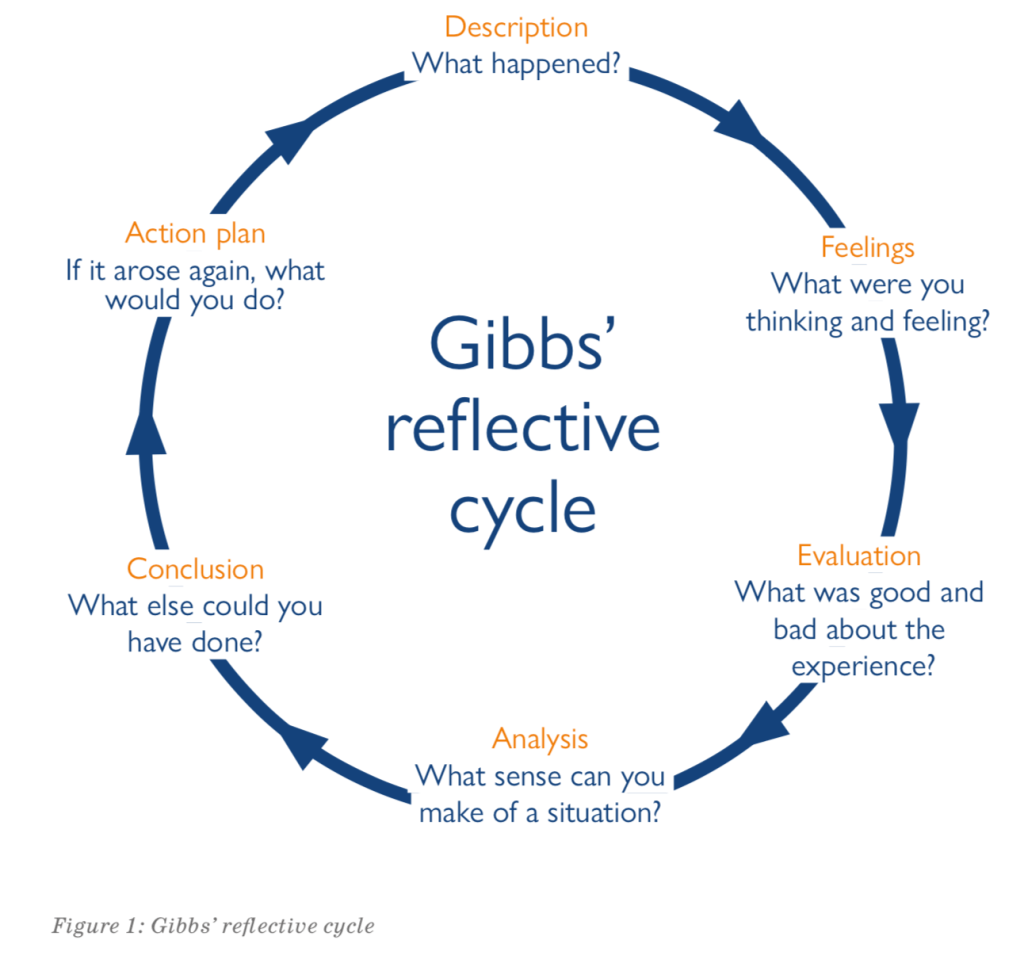
Having identified the key things I want to work on I will use the “Gibbs’ Reflective Cycle” to act upon the goals I have set myself. The “Gibbs’ Reflective Cycle”, developed by Graham Gibbs in 1988, gives structure to learning from experiences; it is one of the most used and most famous cyclical methods of reflection. It offers a framework for examining experiences, and is comprised of six stages:
- Description – What happened?
- Feelings – How do you feel about what has happened?
- Evaluation – What was good and what was bad?
- Analysis – What sense can we make of what has happened?
- Conclusion – What else could you have done?
- Action plan – What would you do if differently if you did it again?
When using the “Gibbs’ Reflective Cycle” I intend to use the following questions to help guide me through the different stages as I know from previous experience that reflecting on my practice and putting those reflections down into words isn’t something that I find easy to do:
- Description: The main points to include here concern what happened. Helpful questions:
- What happened?
- When and where did it happen?
- Who was present?
- What did you and the other people do?
- What was the outcome of the situation?
- Why were you there?
- What did you want to happen?
- Feelings: Explore any feelings or thoughts had during the experience and how they may have impacted the experience. Helpful questions:
- What were you feeling during the situation?
- What were you feeling before and after the situation?
- What do you think other people were feeling about the situation?
- What do you think other people feel about the situation now?
- What were you thinking during the situation?
- What do you think about the situation now?
- Evaluation: Evaluate what worked and what didn’t work in the situation, while trying to be as objective and honest as possible. Focusing on both the positive and the negative aspects of the situation, even if it was primarily one or the other. Helpful questions:
- What was good and bad about the experience?
- What went well?
- What didn’t go so well?
- What did you and other people contribute to the situation (positively or negatively)?
- Analysis: Analysis of what has happened and try to extract meaning from it; specifically targeting the aspects that went well or poorly and asking why. Helpful questions:
- Why did things go well?
- Why didn’t it go well?
- What sense can I make of the situation?
- What knowledge – my own or others (for example academic literature) can help me understand the situation?
- Conclusions: Develop conclusions about what happened; summarise what I have learned and highlight what changes could improve the outcome in the future. Helpful questions?
- What did I learn from this situation?
- How could this have been a more positive situation for everyone involved?
- What skills do I need to develop for me to handle a situation like this better?
- What else could I have done?
- Action plan: Plan what I would do differently in a similar or related situation in the future. Don’t just plan what I would do differently, but also how I will make it happen; this will help to make sure the same mistakes aren’t made repeatedly. Helpful questions:
- If I had to do the same thing again, what would I do differently?
- How will I develop the required skills I need?
- How can I make sure that I can act differently next time?
The “Gibb’s Reflective Cycle” can either be used as a stand-alone model or iteratively, repeatedly using the cycle and making changes and improvements to a practice whenever a task is performed. When performing the “Gibb’s Reflective Cycle” repeatedly it can also be referred to as Praxis. Praxis is an ancient Greek word meaning the process by which a theory, lesson, or skill is enacted, embodied, or realised. Praxis is also where we get the word practice from which has two meanings:
- Application: “the actual application or use of an idea, belief, or method, as opposed to theories relating to it.”
- “The principles and practice of teaching”
- Repetition: “the customary, habitual, or expected procedure or way of doing something.”
- “Product placement is common practice in American movies”
(Oxford English Dictionary n.d.)
- “Product placement is common practice in American movies”
Using this method, I plan to approach each task by first identifying elements to focus on, then creating a plan on how to address them, and finally reflecting and evaluating my progress afterward.
“Reflective thinking turns experience into insight.” – John C. Maxwell. (2003: 102)
This second of this week’s lecture was focused on creativity. I have always considered myself creative in some form or another but have never really taken the time to question what creativity is. When looking at what creativity is I decided to first look at what the Oxford English Dictionary defines creativity as, which is:
“the use of imagination or original ideas to create something, inventiveness.”
(Oxford English Dictionary n.d.)
Sir Ken Robinson believes that “creativity is the application of imagination, the process of having original ideas” (2010). While creativity and imagination are both fundamental to the human experience, only through the process of imagination can we create. David Bohm (2004) however believes that it is impossible to define the term creativity and converges on the notion that the creative process is the pursuit of new knowledge. He also insists that creativity is not constrained to any one discipline and that it is present in all fields of study where imagination is employed to solve problems.
During the lecture, we listened to an excerpt from a Grayson Perry interview on BBC Radio 4 (2017) where he discusses video games. Perry has a very negative view of video games; describing them as being trapped in someone’s else imagination and criticises them for their overuse of concepts like steampunk which he cites as being cringeworthy and clichés. He believes that video games all use the same theme and only show the stereotypical male viewpoint. While I disagree with him, I can understand where he is coming from in terms of video games often reusing the same tropes over and over again. However, games are not the only medium that does this. Film and TV often remake the same story, again and again, often stealing stories from literature, does this mean that films like Sherlock and Romeo and Juliet are also Cliché?
While I appreciate that some games, like the steampunk genre, rely heavily on fantasy tropes to carry the story of the game I do disagree with him painting games all with the same brush. While some games can come across as cringy due to their reliance on tropes; there are a lot of excellent games out there, with well thought out and developed narrative and art styles. Like with books and art, games can be incredibly immersive; with the unique ability to not just transport you to another world but to make you an active participant in the story. There is also a reason that certain settings or genres of games are frequently used and that is because they cater to the largest audiences who enjoy them and will regularly and continually buy and play those types of games. Just because a genre has the tendency to come across as cliché doesn’t mean that it is inherently bad.
One of the things that I love about games is that each person has a different experience, based on their own experience and interpretations. Because of this, I find Perry’s opinion of games to be quite narrow-minded, and shallow as there are so many different games genre available, and yet he has tarnished them all with the same brush based on his experience of one. However, his opinion is a good example of how subjective creative processes and products like games are and that you can’t please everyone. Moving forwards my goal will be to produce games that I am proud of and enjoyed making which appeals to a specific target audience, by doing this I hope to limit the subjectivity of who will enjoy the game allowing the feedback to be more about the experience of playing the game rather than what it’s type is.
“Creativity is intelligence having fun.”
Albert Einstein
References:
BOHM, David. 2004. On Creativity. 2nd edn. London and New York: Routledge
GIBBS, G. 1988. Learning by Doing: A Guide to Teaching and Learning Methods. Oxford: Further Education Unit.
MAXWELL. John C. 2003. Thinking for a Change: 11 Ways Highly Successful People Approach Life and Work. New York: Warner Books
OXFORD ENGLISH DICTIONARY. n.d. Oxford: Oxford University Press.
PERRY, Grayson. and Naomi, ALDERMAN. 2017. “Can computer games be called art?” Only Artists Series 1 [radio broadcast] BBC Radio 4 [online]. Available at: https://www.bbc.co.uk/programmes/b08l7yvh [accessed 23 September 2021].
 Fern Griffiths
Leave a comment