The second lecture for this week looked at empathy and how emotions and empathy influence game design. One of the reasons I love games is their ability to tell connective and emotive stories, but how are games able to make players feel these emotions? In order to feel emotions, a person needs empathy. The Oxford English Dictionary defines empathy as “the ability to understand and share the feelings of another.” Empathy is an important part of understanding emotions in others, from a psychology point of view empathy can be defined in the following way:
“Empathy is often defined as understanding another person’s experience by imagining oneself in that other person’s situation: One understands the other person’s experience as if it were being experienced by the self, but without the self actually experiencing it. A distinction is maintained between self and other. Sympathy, in contrast, involves the experience of being moved by, or responding in tune with, another person”
(Hodges and Myers 2007).
Empathy develops in childhood, as we grow, we develop a framework to apply empathetic thinking to make it fit a larger society, something that is commonly referred to as ethics. So when designing a game it is important to think about ethics. Ethics developed as a set of rules for living in Greece about 3000 years ago. Plato is famously cited as saying “good people do not need laws to tell them to act responsibly, while bad people will find a way around the law”. Plato was one the earliest propagators of this theory of what is now called Moral Agency, that we should attempt to be moral agents in the world and that this is achieved by traits like courage, honesty, and temperance.
For early video games like Space Invaders and many modern FPS games the moral agency is very black and white, you have an enemy that you have to shoot to prevent them from killing other people including the character you control. Video games are binary systems, they like clear distinctions; until recently the conditional logic of computer systems define their environments as either true or false, friend or foe, dead or alive. A lot of modern games however are trying to give the player more moral agency, where there isn’t a clear divide between right or wrong. To achieve a deeper moral agency the use of Fuzzy Logic could be the way forward.
Fuzzy Logic was first introduced in the 1960s by Dr. L. Zaden and is a way of presenting a level of ambiguity in a system and correlates much better to how humans may feel in a given situation. It is an approach to computing based on degrees of truth, it continuously adjusts its outputs based on inputs with its level of on and off is based on a scale. When applied to video games it can be used to create moral grey areas rather than just black and white outcomes.
Video Games are at their core a series of patterns and yet they are able to elicit strong emotional responses from the players as a result of their ability to tap into a person’s empathy. Lots of things can impact a person’s empathy, but to get a specific response from a player Game Designer must understand their players. The more you know about the intended audience, the more you can pick which words, visuals, and game systems to use in order to achieve the desired emotional response. In order to understand how empathy is achieved in video games, I am going to look at a few different games which all achieve empathy in different ways; Papers, Please (2013), The Last of Us: Remastered (2014), The Last of Us: Part 2 (2020) and Unravel (2016).
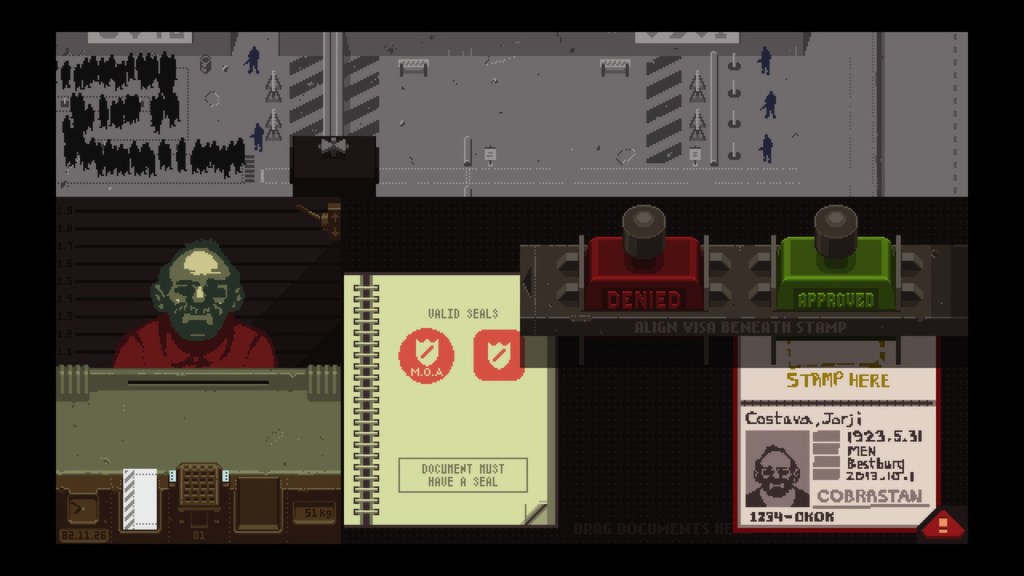
The game Papers, Please, places the player in the role of an anonymous border control agent, the only backstory the player is provided with is that the character is trying to make enough money to support their family. The player is tasked with checking passports at the border control of a country. If all the papers match then you let them through if not then you deny them entry. The more people you process the more money you make. As the game progresses the requirements you have to process get more complicated, because of this the player will process less people and they will earn less money, at the same time the character’s rent will go up and they’ll need more money for medicine. At this point the game starts to give the player tough decisions. Empathy is achieved in Papers, Please by placing the player in the role of an anonymous border control agent that the player is able to inhabit; when their family gets sick and needs medicine the player is able to feel empathy for the character as this is a relatable experience. The character is just trying to do their job and support their family but they, and by association the player, are put in a difficult position of just trying to do their job and while also being in control of other people’s lives. This places the player in a moral grey area as though you are just following the rules your actions, who you do and don’t let through the border, have unforeseen consequences. The game not only makes you feel empathy for the character you inhabit but also for the desperate people who spend all day queueing with the hope of getting into the country. The game gives glimpses of the other character’s stories when they’re at their most vulnerable with their fates being held in the player’s hands; with the player’s choice having the impact of either keeping families together or splitting them up. Here, empathy is created, not by telling one specific story, but by giving the player glimpses into a lot of stories that the player can potentially relate to.
Unlike Papers, Please, The Last of Us series achieves empathy by limiting the cast to just a handful of main characters who have dramatic and personal stories which the player gets to be an active participant in. By choosing to tell personal stories that unfold over the course of the game the player feels more emotionally connected to the characters and they are able to put themselves in the character’s shoes leading the player to feel empathy for them. In The Last of Us the player gets to experience the relationship between Ellie and Joel develop and grow over the course of the game from the perspective of Joel. By showing the relationship from Joel’s point of view the player’s own relationship with Ellie is mirrored; like Joel, the player is getting to know Ellie and as her relationship develops with Joel it also develops with the player. The Last of Us causes the player to feel empathy by putting us into a parental and protective role with Ellie and showing how the relationship between her and Joel evolves. By controlling Joel a connection is formed between the player and the game with the player being able to project themselves onto Joel so that the emotions that he feels matches what the player feels. By telling personal and specific stories The Last of Us creates empathy as the player is able to put themselves in the character’s shoes. You may not be able to relate to the main story of The Last of Us as we have not experienced a zombie apocalypse, but the theme of a parent caring for a child is a familiar theme that most people are able to connect with emotionally.

This emotional connection with the characters, and the empathy it creates, was clearly demonstrated when The Last of Us: Part 2 came out. The sudden death of Joel resonated with the fans and the international outrage and anger on social media demonstrated how emotionally invested with the story and the characters the fans truly are. This need of being able to empathise with the characters in order to fully connect with the story was something that the developers were very aware of. In an interview, Neil Druckmann states that:
“The challenge is what we said all along: if people don’t ever understand Abby, the whole game fails. It doesn’t work. If all the way through, you just want nothing but revenge and never empathise with her, the game falls apart. And that’s where most of the effort for the game went, to make Abby… not necessarily good. The pitfall a lot of writers with this kind of story fall into is like, OK, we need people to like Abby, let’s make her perfect. She does nothing wrong. She only makes moral choices. But no, that’s not where empathy comes from. Actually, empathy comes from making mistakes and challenging and trying to correct your mistakes and overshooting and messing up. I guess our hope is that people see her as a human, as a complex human”
(Neil Druckmann 2020)
This decision, to have the player play as Abby partway through The Last of Us: Part 2 was one that divided the fanbase with a large majority of the fans hating being forced to play as Abby. I, however, didn’t mind playing as Abby and I actually emphasised a lot with her character the more that I played as her; if hers and Ellie’s roles had been reversed she would have made an interesting main character. Ellie’s and Abby’s motives and stories are very similar and being made to play as Abby forces the player to acknowledge this. Abby’s story is a warning to Ellie that her path of revenge won’t bring her the closure she is looking for. By making the player experience both sides of the story the player is able to empathise with both characters’ motives, they may not necessarily agree with them, particularly in regards to Abby, but the player is able to understand them and connect with them emotionally.

Empathy is no longer just a biproduct of telling stories in games but something that is actively being used a game mechanic. The game Unravel (2016) actively uses empathy as a mechanic to make people fall in love so that the developers could break their hearts a little and then make everything better in the end, the whole purpose and point of the game was to inspire empathy (Sahlin 2017). Martin Sahlin, the Creative Director of Coldwood the studio behind Unravel, said that their aim when making the game was to create deeper engagement between the player and the game, as well as a game that was rich, meaningful and a positive influence (Sahlin 2017). Games like this though only work if the players actually care for the character. The creators of Unravel achieved empathy by making the player inhabit a character that is small and weak in comparison to their world and then make them go on a dangerous adventure. Sahlin states that two of the main ways they achieved empathy was to make the character “Yarny” aware of their surrounds something they call “situational awareness”, and to make him react emotionally to what is happening to him (2017). By having Yarny react to his environment like a living, intelligent being it makes the character feel more alive which allows the player to connect and empathy with the character, enabling the player to feel what Yarny feels (Sahlin 2017).

From this weeks lecture and my own research it has become very clear how important empathy is for allowing a player to connect with a game and its characters. Games like Papers, Please does this by placing you in the position of a character and allowing you to build the character’s story based off snippets of information and your own experiences while games like The Last of Us series and Unravel builds empathy by telling specific and personal stories that the player gets to experience unfold. As I am interested in Narrative Design it is really interesting to see how different types of games achieve empathy and how important it is as a Game Designer to understand who you are making a game for. Empathy can be a powerful storytelling tool when used well, especially for interactive mediums like games; allowing for stories to be told without words. I have found reverse engineering, analysing, and breaking down how these games achieve empathy a really interesting and helpful technique for better understanding empathy as a game mechanic and narrative design tool. I will take what I have learned about empathy in video games and how it is achieved and apply it to my future projects in order to create more emotive narratives, starting with my first game sprint. As the game for this first sprint is only 5 minutes long I will use the technique of having an anonymous character on which the player can project their own experiences onto, used by Papers, Please, to help achieve empathy for this first game sprint.
“We feel that the interactive mediums have an untapped potential to touch the feelings of the player. You have the connectivity; the fact that I’m actually in the world and participating in what’s happening on the screen, in front of me gives us some sort of advantage to make you feel connected with what’s actually happening. At Naughty Dog, what we’re trying to do is pair story and gameplay together. If we can make you feel like you’re actually with these characters on that journey, and you’re invested in those stories and those characters then you’re feeling, in theory, the same thing that their feeling.”
Bruce Straley (2014)
References:
DRUCKMANN, Neil. 2020. Interviewed by Aoife Wilson in Eurogamer [online]. Available at: https://www.eurogamer.net/articles/2020-07-01-a-spoiler-heavy-interview-with-the-last-of-us-part-2-director-neil-druckmann [accessed 29 September 2021]
HODGES. Sara. D. and Michael. W. MYERS. 2007. “Empathy”. In Roy F. BAUMEISTER (ed) “Encyclopedia of Social Psychology: Volume 1”. California: SAGE Publications, Inc. pp. 296-298.
OXFORD ENGLISH DICTIONARY. n.d. Oxford: Oxford University Press.
SAHLIN, Martin. 2017. GDC – Unravel: Using Empathy as a Game Mechanic [YouTube user-generated content]. Available at:https://www.youtube.com/watch?v=0ymAdeWrsYM
Games:
The Last of Us: Remastered. 2014. Naughty Dog, Sony Interactive Entertainment.
The Last of Us: Part Two. 2020. Naughty Dog, Sony Interactive Entertainment.
Papers, Please. 2013. Lucas Pope, 3909 LLC
Unravel. 2016. Coldwater Interactive, Electronic Arts
Figures
Figure 1: Papers, Please. 2013. Lucas Pope, 3909 LLC
Figure 2: The Last of Us: Remastered. 2014. Naughty Dog, Sony Interactive Entertainment.
Figure 3: The Last of Us: Part Two. 2020. Naughty Dog, Sony Interactive Entertainment.
Figure 4: Unravel. 2016. Coldwater Interactive, Electronic Arts



 Fern Griffiths
Leave a comment