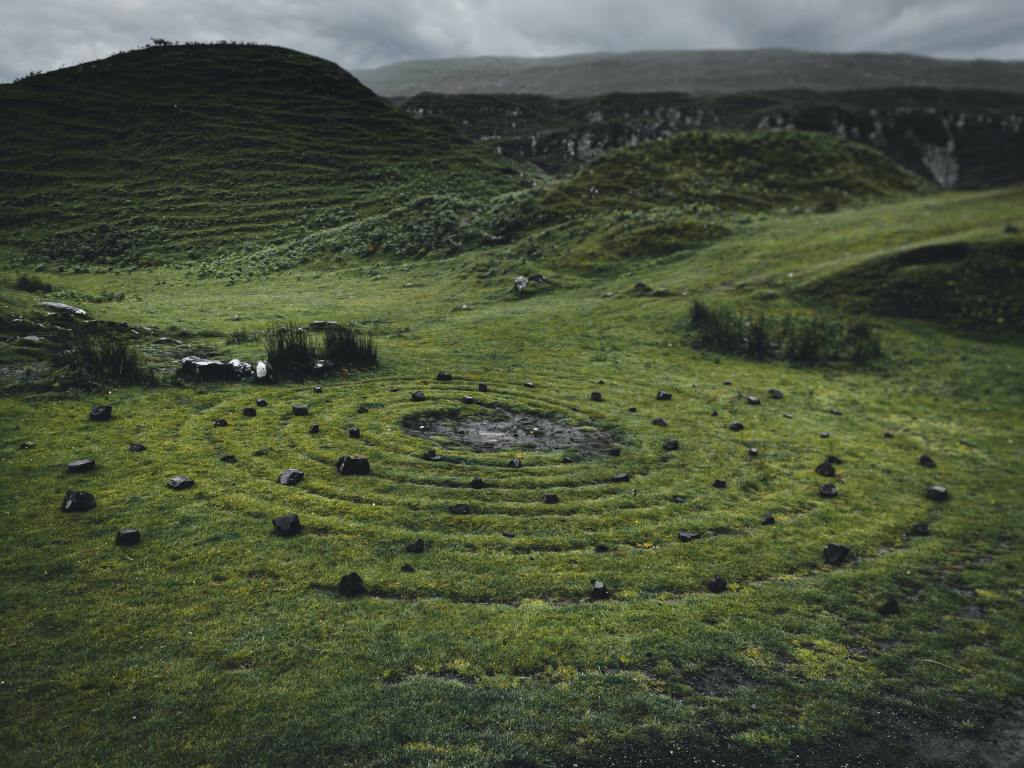
As I have decided to focus on Celtic/Gaelic folklore I have taken some time to research the creatures found within it that I could potentially use. Celtic/Gaelic mythology can be further divided into different regions of the UK, though they share much of the same folklore. As the different regions contain folklores unique to that location, I have chosen to focus my research predominantly on Scottish folklore as it is the area that interests me the most.
Fae
- Within Scottish folklore, the Fae world is said to be inhabited by two types of Fae, the “good” and the “wicked”. The good Fae are known as the Seelie Court and like to play pranks on humans but will also help those who need it. The Wicked Fae are called the Unseelie Court and are those who wish to do harm to humans or steal away children and replace them with changelings. The Fae are extremely private, clever, mischievous and possess a variety of magical powers (Briggs 1976).
Cù Sìth
- A mythological hound found in Scottish folklore, its name means fairy dog. The Cù-sìth is believed to make its home in the clefts of rocks and to roam the Highlands, it is usually described as having shaggy, dark green fur and being as large as a small cow. According to folklore it was capable of hunting silently, but would occasionally let out three terrifying barks that could be heard for miles around and even far out at sea. Those who hear the barking of the Cù-Sìth must reach safety by the third bark or be overcome with terror to the point of death (Campbell 1900, Shaw 1997).
Cat Sìth
- Also spelt Cait Sìth is a fae creature said to resemble a large black cat with a single white spot on its chest, its name means fairy cat. Legend has it that the spectral cat haunts the Scottish Highlands with the legends surrounding it being most common in Scottish folklore, but a few occur in Irish. Some common folklore suggested that the cat-sìth was not a fae, but a witch that could transform into a cat nine times (Campbell 1900, Shaw 1997).
Wulver
- Originating in the Shetland Islands was believed by the ancient Celts to be a symbol of the in-between stage of man and wolf, actually evolving from wolves, never having been a man at all. Due to their werewolf-like appearance, they are often wrongly assumed to be dangerous creatures by those who don’t know the original folklore. These Gaelic folktales told that the Wulver would take pity on the needy by leaving fish on the windowsills of poorer families in Scotland. Unlike other stories of werewolves, the Scottish Wulver was considered kind and often helped lost travellers, by guiding them to nearby towns (The Scotsman 2016 and Macqueen 2018).
Kelpie
- Kelpies are shape-shifting spirits said to inhabit the lochs and rivers of Scotland. It is usually described as a black horse-like creature, able to adopt human form, that preys on any humans it encounters. One of the kelpie’s identifying characteristics is that its hooves are reversed in comparison to those of a normal horse. Kelpies are said to take on the appearance of a tame horse in order to lure people onto their backs so they can drown them. (Campbell 1900, Shaw 1997).
Nuggle
- A mythical water horse of primarily Shetland folklore where it is also referred to as a shoepultie or shoopiltee on some parts of the islands. They are always male in gender and while there have been fleeting mentions of them in connection with the Orkney islands but they are more frequently associated with the rivers, streams and lochs of Shetland. Their appearance can lead to confusion with Kelpies but unlike this more evil counterpart, the Nuggle has a fairly gentle disposition being more prone to playing pranks and making mischief rather than having malicious intents. The Nuggle has the appearance of a well looked after shetland pony and unlike the Kelpie, their hooves are not reversed (Campbell 1900, Shaw 1997).
Selkie
- A shapeshift creature capable of changing from a seal to a human by shedding its skin. The folktales of Selkies frequently revolve around female selkies being coerced into relationships with humans by someone stealing and hiding their sealskin, which prevents them from being able to return to the ocean (Towrie n.d. Visit Scotland n.d).
Brownie
- A brownie, also known as a brùnaidh or gruagach in Scottish Gaelic (DSL n.d), is a household spirit from Scottish folklore that is said to come out at night while the owners of the house are asleep and perform various chores and farming tasks. The owners of the house must leave a bowl of fresh milk or cream as an offering for the brownie, usually by the hearth. Like other Fae folk, Brownies can be easily offended and will leave their homes forever if they feel they have been insulted or in any way taken advantage of. Brownies are characteristically mischievous and are often said to punish or pull pranks on lazy servants (Briggs 1976).
Goblin
- Goblins is a blanket term, common in English, Scottish, and Irish folklore, for all sorts of evil or mischievous spirits. The term often refers to small, grotesque, monstrous creatures that are obsessed with gold and jewellery
- Redcaps
- The Redcap is a type of malevolent, murderous goblin found in Scottish and British folklore. Always shown as male, is said to inhabit ruined castles along the Anglo-Scottish border, especially those that were the scenes of tyranny or wicked deeds. Its name come from the fact they are known to soak their caps in the blood of their victims to die them a bright red colour. They are described as being short in appearance and resembling an old elf with long prominent teeth, skinny fingers armed with talons like eagles, large eyes of a fiery red colour, grisly hair streaming down his shoulders, iron boots, a pikestaff in his left hand, and a red cap on his head (Briggs 1976).
- The Redcap is a type of malevolent, murderous goblin found in Scottish and British folklore. Always shown as male, is said to inhabit ruined castles along the Anglo-Scottish border, especially those that were the scenes of tyranny or wicked deeds. Its name come from the fact they are known to soak their caps in the blood of their victims to die them a bright red colour. They are described as being short in appearance and resembling an old elf with long prominent teeth, skinny fingers armed with talons like eagles, large eyes of a fiery red colour, grisly hair streaming down his shoulders, iron boots, a pikestaff in his left hand, and a red cap on his head (Briggs 1976).
- Hobgoblin
- A household spirit, that was once considered helpful, but since the spread of Christianity has often been considered mischievous. They are described as being small, hairy little men who, like their close relatives the Brownies, are often found within human dwellings. In return for food, they will often do odd jobs around the house such as dusting and ironing while the family is asleep. While brownies are considered more peaceful creatures, hobgoblins are more fond of practical jokes. Attempts to give them clothing will often cause them to leave forever, though whether this is due to offence or not wanting to work in new clothes is unknown (Briggs 1976).
- Redcaps
Black Dog
- Many types of black dogs exist in Celtic/Gaelic folklore with the term normally referring to supernatural, spectral or demonic entities often described as being unnaturally large with glowing red or yellow eyes and are generally regarded as sinister or malevolent. One such type is the Church Grim, a guardian spirit in Celtic and Nordic folklore that oversees the welfare of a particular Christian church, and protects the churchyard from those who would disturb the peace or commit sacrilege against it. Due to their similar appearance to other malevolent creatures, the Church Grim is often considered an ill-fated sign or a warning of bad things to come for a person to see one (Campbell 1900).
Trolls
- In the Shetland and Orkney islands, Celtic areas once settled by Scandinavians, trolls are called trows and appear as either monstrous giants or small creatures who dwell in mounds or near the sea. They are said to be both big, stupid and greedy but also kind and wise. As with their larger Norse cousins, they are nocturnal creatures that only come out after dark as exposure to sunlight will cause them to be turned to stone. Trows traditionally have a fondness for music, and the folktales surrounding them tell of their habit of kidnapping musicians and taking them back to their den to play music for them (Briggs 1976, Campbell 1900).
All these creatures are often portrayed as scary, monstrous creatures particularly in video games were they often many of the enemies that players have to defeat, such as the Wulver in the 2018 Nordic-inspired reboot of God of War. While not all of these creatures will be suitable for the final game I feel that I have researched enough creatures to be able to start planning the narrative and begin to develop the gameplay for the prototype.
“In the Celtic mind, humanity and the animal kingdom were intimately connected. This interconnection with nature was reflected in their gods, who took the forms of the animals they revered, blurring the distinction between the animal and human realms.”
Stephanie Woodfield (2011)
References:
BRIGGS, Katharine, Mary. 1976. An Encyclopedia of Fairies, Hobgoblins, Brownies, Boogies, and Other Supernatural Creatures. New York, Pantheon Books
CAMPBELL, J. G. 1900. Superstitions of the Highlands and Islands of Scotland: Collected Entirely from Oral Sources. Glasgow: Maclehouse.
DICTIONARIES OF THE SCOTS LANGUAGE. n.d “BROONIE, Brownie, Brouny, Brunie” DSL [online]. Available at: https://www.dsl.ac.uk/entry/snd/broonie_n1 %5Baccessed 11 February 2022].
MACQUEEN, Douglas. 2018. “Wulver: Shetland’s kind and generous werewolf” Transceltic [online]. Available at: https://www.transceltic.com/scottish/wulver-shetlands-kind-and-generous-werewolf [accessed 11 February 2022].
SHAW, P. Carol. 1997. Scottish Myths and Customs. HarperCollins
THE SCOTSMAN. 2016. “Scottish myths: Wulver the kindhearted Shetland werewolf” The Scotsman [online]. Available at: https://www.scotsman.com/news/people/scottish-myths-wulver-kindhearted-shetland-werewolf-2463904# [accessed 11 February 2022].
TOWRIE, Sigurd. n.d. “The Selkie-folk” Orkneyjar [online]. Available at: http://www.orkneyjar.com/folklore/selkiefolk/index.html [accessed 11 February 2022].
VISIT SCOTLAND. n.d. “Ghost, Myths and Legends” Visit Scotland [online]. Available at: https://ebooks.visitscotland.com/ghosts-myths-legends [accessed 11 February 2022].
WOODFIELD, Stephanie. 2011. Celtic Lore and Spellcraft of the Dark Goddess: Invoking the Morrigan. Llewellyn Publications, U.S
Games:
God of War. 2018. Santa Monica Studio, Sony Interactive Entertainment.

 Fern Griffiths
Leave a comment